In the Dungeons & Dragons 5th Edition(DnD 5e), all Bards have the ability of full spell casting progression. It means that they can ultimately gain access to the 9th level of spell that is the most significant magic tier.
Support and control spells are added to the bard’s spell casting lists. These spells let them disable foe, buff, and heals allies. Without these spells, you have to face many problems both times during in and out of combat. There are different spells such as Eldritch blast, Phantasmal force, phantasmal killer etc.
All players must choose their best bard spells with care because they have a limited number of opportunities for spell learning and switching. Choose the spell that you consider beneficial for your adventure career. Always try to select the suitable spell because the bards can choose a limited number of spells from their spell casting list.
In this article, we bring a list of 20 bard spells 5e. We will explain their features and usage at their levels. This will help you to select a suitable bard for your adventure career carefully.
Top 20 Best Bard Spells 5e (D&D):
1. Polymorph
Source: Player’s Handbook
The most powerful spell is a polymorph, and it stands first due to its versatility. It is a 4th- level spell, while bards can only acquire at seven levels.
It is a multiple purpose spell allowing you to change a target into a beast with a challenge rating that is mainly equal to and less than its rating.
The 5e has a large number of repository beasts. In this case, the polymorph can give transportation, combat, utility, and many more tools to your bard.
With its help, you can change anyone into a suitable creature for a task instantly. You can also change your enemy into a harmless thing like a turtle.
It is one of the most flexible spells that will prove beneficial during your all adventuring career.
This spell has weak ordinary intelligence that saves you from enemies. You can only take advantage of this spell if you continuously concentrate on it.
2. Synaptic Static
Source: Xanathar’s Guide to Everything
The synaptic static helps to remove some serious high levels of damaging options.
At the 5th and higher level of slots, the bards release a boom of psychic energy. Each creature deals with this psychic damage within a range of 20- feet from a designated point.
Besides this, all those targets who fail to achieve the intelligence save from synaptic suffer a status effect that results in the extraction of d6 from their attack rolls and ability checks. It also subtracts the constitution, saving throws just for a minute until they save themselves entirely from the effect.
3. Dominate Monster/Dominate Person
Source: Player’s Handbook
The dominate person is a 5th-level spell, while the dominate monster is the 8th-level spell. Both are charms spells that give your bards power to command if the other creature is not outright controlled.
The dominate monster is a good version of the spell according to the object. It permits you to target those creatures who are not charmingly immune. On the other hand, the dominant person also has a similar function, but it targets only humanoid type creatures.
All the targets who fail their saves will remain under your control for spell duration until you maintain the concentration. However, they can also save themselves against the spell whenever they take damage.
4. Forcecage
Source: Player’s Handbook
Forcecage is the amazing 7th-level bard dnd 5e spell that creates an invisible prison of all the magical forces. This prison takes the shape of a cage or a box.
To avoid this effect, most spells need some saving throw. Moreover, a bard can trap creatures into this prison easily as long as the target comes into the prison dimensions.
In this effect, all the spells have not passed in and out through this area. On the other hand, if you select to create a box, all the other attacks and abilities will also be blocked.
This spell effect lasts at least one hour without any concentration needed. Teleportation is the only way if any spell wants to escape from the box. Although this escaping option also has a failure chance.
5. Invisibility/Greater Invisibility
Source: Player’s Handbook
Invisible enemies are the more threatening and powerful one. The invisibility is the 2nd- level spell that permits your bards to change a target invisible at least for one hour. This effect stays until you maintain concentration and the target holds back from attacks and casting of spells.
The invisibility opens many opportunities for scouting, escaping, infiltration, and other horseplay that needs discretion.
It’s another version is the greater invisibility that is a 4th-level spell. It lets a target hold on invisible after casting spells and attacking. This thing makes it a perfect combat buff, even for a shorter duration.
6. Sending
Source: Player’s Handbook
The sending spell is considered by all those bards who obey this motto “communication is key.”
It is a 3rd level option that allows the bards to pass on a 25- word message to all anyone they are familiar with. Besides this, the target also can reply to their 25-word message.
The best thing about this spell is that there are no geographical boundaries of the message sending. However, the sending becomes more effective and perfect if you and your target lie on the same plane.
This spell is extremely beneficial for the maintenance of communication without any distance between all of your allies.
7. Dimension Door
Source: Player’s Handbook
The dimension door is a 4th-level spell that provides the Bards their vital teleportation capacity with a range of up to 500 feet.
This spell is the best choice under quick escaping, infiltrating, and repositioning situations.
If you want to make their spell more perfect, you can do it by taking any other creatures and you, but you can use them until they are in the same size category as in the smaller one.
8. Hypnotic Pattern
Source: Player’s Handbook
The hypnotic pattern, just like its names, creates short color patterns that distract the targets.
It is a 3rd-level spell that forces the charmed condition in a 30-foot cube. They only target those who fail to save their wisdom.
The spell gives trouble to those targets that are in the capacitor. It also reduces their speed to 0 when they are affected by spells.
If targets fail to save, they become disabled. They become normal again only if they take damage and if any other creature stimulates them with an action.
This spell is a perfect option for bards who want to control battlefield threats.
9. Dissonant Whispers
Source: Player’s Handbook
The dissonant whispers are the most exclusively available 1st-level spell to bards.
At its lowest and weaker level, it deals with 3d6 psychic damage. Its real power is that it forces the target to go away from your side in a failed place.
There is a lot of potential damage when your allies capitalized, and attack opportunities produced by this movement creates them.
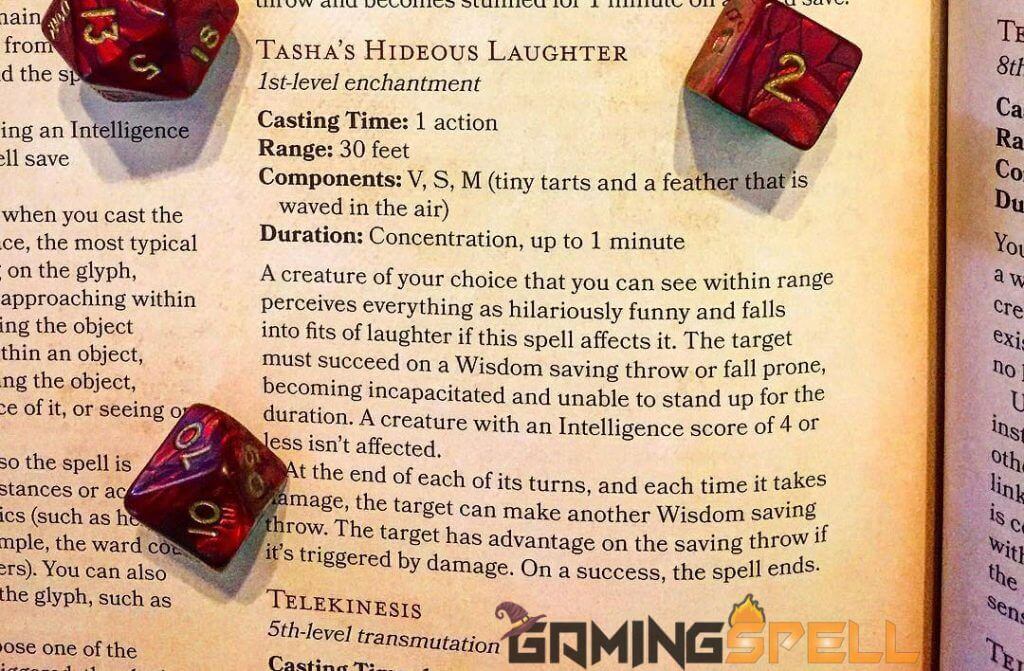
10. Tasha’s Hideous Laughter
Source: Player’s Handbook
Tasha hideous laughter is the 1st- level spell that has an option to disable a rival entirely.
It undertakes those targets that fail the wisdom saving throw against this spell. These targets become incapacitated and fall susceptible. This means that all these targets now can not take any stand up or further action.
In later turns, when the target can save against the spell’s effect or after the damage, this Tasha hideous laughter can take these targets out while giving you a favored position.
11. Hold Monster/Hold Person
Source: Player’s Handbook
The hold monster is the 5th-level spell that is fulfilled by both non-dead and potentially paralyzing creatures. It causes all the attacks that are against it and hits it critically. Besides this, it gives creatures no immunities to their paralyzed condition.
When the bards have a good deal of damaging options, they can access all those spells that can empower their allies and stop their enemies from their harm.
Hold Person is the 2nd 0 level spell while it has all the similar functions like this spell. The only difference between them is that it is a higher-level version. However, only humanoid creatures are targeted by this spell.
12. Faerie Fire
Source: Player’s Handbook
The faerie fire is the 1st-level spell in which the bards can allow their allies to hit critically and land their attacks.
This spell effect resists until your bards maintain their concentration. The targets are covered in a colorful light who fail to save their ability against this spell. This light gives them an advantage over all the attacks that roll against them. On the other side, the affected creature of this spell no longer takes advantage of invisibility.
13. True Polymorph
Source: Player’s Handbook
The true polymorph is the 9th-level spell, and it can kick off the top ten with gusto power.
A true polymorph is a strong spell that gives you transformation power at your fingertips.
This spell has the power to change any object and creature into another object and creature. Its changing ability makes it an in-convertible upgrade.
This spell,like the other 9th-level spell, can rank you much higher. But this spell is not very helpful if you as a bard may not reach 17th-level and higher.
This spell’s benefit is that it can solve all your bard problems by taking out its right transformation.
14. Suggestion/Mass Suggestion
Source: Player’s Handbook
The suggestion is a 2nd-level spell that attracts a target to take a particular course of action according to their capacity. Moreover, it also contains a 6th-level spell version with mass suggestions. This level affects more number of creatures for a long run without using any caster’s concentration.
This spell application mainly depends on the situation at hand because it is used for neutralizing enemy threads, information gathering, and many other things.
Besides this, it’s all potential; mass suggestions and other suggestions depend on your DM’s interpretation of how the targets follow the given directions of action.
15. Enemies Abound
Source: Xanathar’s Guide to Everything
Enemies abound to give you bards control options. During the combat period, it can create a single creator into a wild card for a limited time. You have to randomize your target, attacks, and abilities in this spell because the target has no power to discriminate between its allies and enemies.
This spell can give you a lot of side advantages in the field depending on your enemies.
16. Foresight
Source: Player’s Handbook
The foresight is the 9th level spell that is the most potent buff that can be casted by bards.
It gives you the target advantage on attack rolls, ability checks, and saving throws. Moreover, they can roll a d20 twice and also give you better results.
The most significant advantage of this spell is that its effects last at least 8 hours without any concentration. This spell renders all those targets who are helpless.
The foresight is the best spell if your bard wants to support themselves and other allies.
17. Otto’s Irresistible Dance
Source: Player’s Handbook
It is a 6th level spell that forces the creatures to dance in their places. When the target is affected by this spell, they use all their movement for dancing. The disadvantage of this spell is on attack rolls, and dexterity saves. It has an advantage when the attack rolls are against this spell.
Once the bards emit this spell, they instantly take effect. The only way to shake off the spell is that the target must act to get succession on wisdom saves.
At the minimum level, the spell forces the creatures to do at least one action. Moreover, during its duration time, they have to suffer from the negative effect.
18. Teleport
Source: Player’s Handbook
Teleport is the 7th level spell, and it does precisely the same thing as it sounds.
This spell lets the bards transport themselves immediately. However, on different destinations of the same plane, they can transport themselves at least eight willing targets.
Moreover, you have to bear some margin of error, but it depends on your bard’s similarity with the destination.
If we check this spell overall, it is good and has many advantages. There is no need to transport your whole group; you can teleport your groups in any bad situation.
Overall, instantaneous group teleportation is a great tool to have, as you can significantly cut down travel times or teleport your group out of a bad situation.
19. Psychic Scream
Source: Xanathar’s Guide to Everything
In D&D, the most powerful tools are the 9th- level spells. They have full spell casting just so the bard can unlock.
As the name suggests, the psychic scream deals with all the psychic damage and potential stun. Its range is 90 feet while it deals with only 10 creatures of your choice. Most of the creatures have less formidable intelligence saves that makes them weak and fail to save themselves against these powerful effects.
Spells of this strong and powerful calibre have the potential to end the battle before its beginning.
20. Healing Word
Source: Player’s Handbook
The healing word in 5e is a very simplified spell because the characters only require HP’s silvers to maintain combat readiness.
Furthermore, during your adventuring careers, your allies will naturally need a mid-combat pick-me-up. The Healing word will give the bard’s enough spells to do that.
It is a 1st-level spell that cures your allies of a minute amount while it requires only a bonus action. It usually serves them to prevent them from bleeding.
If you want to take advantage, you should leave your action for cantrips and non-spell options.
FAQ’s about Bard Spells
What are the Best Spells for a Bard?
Here is the list of Best Bard Spells:
- Otto’s Irresistible Dance.
- Foresight.
- Sending.
- Tasha’s Hideous Laughter.
- Synaptic Static.
- Teleport.
- Enemies Abound.
- Psychic Scream.
- Healing World.
- Teleport.
- Suggestion/Mass Suggestion.
- True Polymorph.
What skills should a Bard have?
There could be different skills that a bard has from their background or race. They can choose different skills from the list. The best ones are charisma based skills including Wisdom, Dexterity or intelligence-based skills as a second speciality.
Do bards know all of their skills?
The Bard, along with the Sorcerer and the Warlock, do not prepare spells. Instead, they can cast any spell that they know from the Bard spell list. As a 1st-level Bard, you know four 1st-level spells and have two 1st-level slots.