
Server performance has become a business-critical factor rather than a purely technical concern. Application speed, workload stability, and the ability to scale efficiently all depend on the underlying server CPU. As enterprises handle larger datasets and more concurrent workloads, decision-makers need processors that deliver measurable performance without compromising efficiency.
AMD CPU servers have gained attention by offering high core density, strong memory handling, and scalable architecture. These capabilities directly influence processing speed, virtualization capacity, and long-term infrastructure performance, making AMD CPUs a serious consideration for modern server environments.
Key Performance Metrics and Capability Areas
AMD CPU server performance is defined by specific, measurable capabilities. These include processing core density, thread handling, cache size, memory capacity, I/O bandwidth, virtualization density, power efficiency, and scalability across server configurations. Each of these areas contributes directly to real-world workload performance and infrastructure efficiency.
1. Core Density and Thread Processing Capability
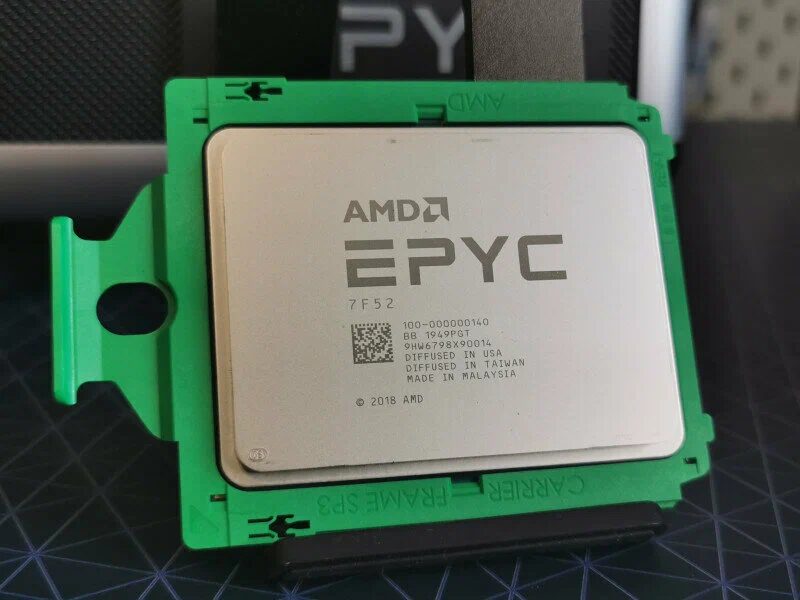
AMD server CPUs support up to 64 cores and 128 threads per socket. In dual-socket systems, this scales to 128 cores and 256 threads per server. This level of parallelism allows servers to handle a high number of simultaneous processes without performance degradation.
High core density improves throughput for multi-threaded workloads such as databases, virtualization platforms, and analytics engines. Platforms such as AMD Ryzen Servers distribute tasks efficiently instead of overloading a small number of cores, resulting in stable and predictable performance under sustained load.
This capability is especially valuable for environments running multiple applications or virtual machines on the same physical hardware.
2. Architectural Efficiency and Cache Capacity
AMD CPUs use a modular architecture designed to optimize performance consistency. High-end configurations include up to 256MB of shared L3 cache per socket, significantly reducing latency for frequently accessed data.
Large cache capacity minimizes reliance on main memory, improving execution speed for transaction-heavy and compute-intensive workloads. This design supports faster context switching and improved application responsiveness, particularly in enterprise environments with continuous workload demands.
Platforms such as AMD Ryzen Servers benefit from this architectural efficiency by delivering balanced performance across both single-threaded and multi-threaded tasks.
3. Memory Capacity and Bandwidth Performance
Memory capability is a critical performance factor in server environments. AMD CPU servers support 8 memory channels per socket, enabling high memory bandwidth and faster data access.
With support for up to 4TB of RAM per socket, AMD CPUs allow large datasets to remain in memory, reducing dependency on storage and improving performance for analytics, virtualization, and in-memory databases.
Higher bandwidth ensures that multiple cores can access memory simultaneously without contention, maintaining performance consistency during peak workloads.
4. I/O Bandwidth and Expansion Capability
AMD CPU servers provide up to 128 PCIe lanes per socket, allowing direct connectivity to high-speed storage, GPUs, and network interfaces. This eliminates I/O bottlenecks commonly seen in systems with limited expansion capacity.
Support for PCIe Gen 4 and Gen 5 doubles data transfer rates compared to previous generations, delivering faster NVMe storage access and lower latency for accelerator-based workloads.
This I/O capability is essential for performance-intensive environments such as AI processing, high-performance computing, and real-time data analytics.
5. Virtualization Density and Resource Utilization
AMD CPU servers are designed to support high virtualization density. With high core counts and large memory capacity, a single server can host 20–30% more virtual machines compared to lower-core alternatives, depending on workload type.
Hardware-assisted virtualization features improve isolation and scheduling efficiency, ensuring predictable performance even when resources are shared across multiple virtual machines.
This capability enables greater workload consolidation, reducing physical server counts while maintaining performance levels.
6. Power Efficiency and Sustained Performance
AMD CPUs are engineered for high performance per watt. Advanced manufacturing processes allow high compute output while maintaining controlled power consumption.
Lower power usage per core enables sustained performance under continuous load without excessive thermal output. This improves reliability, reduces cooling requirements, and supports higher utilization levels over time.
For data centers, improved performance efficiency translates into lower operational costs and more consistent long-term performance.
7. Scalable Server Configurations
AMD CPU servers scale effectively across deployment sizes. Single-socket systems deliver enterprise-grade performance for cost-sensitive workloads, while dual-socket systems support the most demanding applications.
The same architecture underpins both configurations, ensuring consistent performance behavior as infrastructure scales. This allows organizations to expand capacity without redesigning applications or changing CPU platforms.
Many enterprises adopt AMD Ryzen and EPYC Based Servers because this scalability supports growth while maintaining predictable performance characteristics.
8. Built-In Security Supporting Performance
AMD CPUs include hardware-level security features that operate without performance penalties. Memory encryption protects data during processing, while secure boot mechanisms ensure system integrity at startup.
These capabilities enhance reliability and data protection without adding software overhead, preserving performance for mission-critical workloads.
Choosing an AMD Server Partner That Delivers Performance
Established vendors such as Dell and HPE offer AMD-based servers with standardized configurations and broad global support. Lenovo also provides dependable AMD server platforms focused on enterprise stability.
Cloud Ninjas differentiates itself by designing AMD CPU server configurations around specific performance metrics rather than predefined bundles. Core counts, memory capacity, and I/O requirements are aligned directly with workload demands.
This performance-focused approach results in better resource utilization and clearer outcomes, making Cloud Ninjas a strong choice for organizations seeking AMD CPU servers built around measurable performance and capabilities.